2 Flute vs 4 Flute End Mill: Which Should You Choose?
2 Flute vs 4 Flute End Mill: the choice depends on more than whether the workpiece is aluminum or steel. Flute count changes chip space, cutting-edge engagement and the feed required to maintain a suitable chip thickness. The correct choice also depends on radial engagement, cutter geometry, toolholding and machine capability.
This guide compares 2-flute and 4-flute carbide end mills by material and milling operation, explains the feed-rate calculation and provides practical selection examples for CNC machining.
2 Flute vs 4 Flute End Mill: Quick Comparison
Quick answer: a 2-flute end mill usually offers more flute space for evacuating large chips and is a common starting point for full-width aluminum slotting. A 4-flute end mill typically offers more cutting edges and, in comparable conventional designs, a larger core, making it a common choice for steel side milling and finishing.
Neither design is universally better: the specific tool, material and engagement determine the outcome.
| Comparison | 2-flute end mill | 4-flute end mill |
|---|---|---|
| Number of cutting edges | 2 | 4 |
| Flute valley volume | Generally larger in comparable designs | Generally smaller in comparable designs |
| Core diameter | Often smaller | Often larger; can improve stiffness |
| Chip evacuation | More room for bulky chips | Requires appropriate chip volume and evacuation |
| Traditional material starting point | Aluminum and other non-ferrous materials | Steels and suitable stainless-steel operations |
| Typical machining situations | Aluminum slots and high-chip-volume cuts | Steel side milling, profiling and controlled finishing |
| Table feed at identical RPM and fz | Baseline | 2× the calculated feed of a 2-flute tool |
| Main limitation to check | Edge count, core geometry and overall rigidity | Chip space, required feed and machine limits |
Comparison applies to common tools of similar diameter and design. Flute depth, rake, helix, core, edge preparation and coating vary by manufacturer.
Before choosing either cutter, identify the workpiece, whether the operation is a full slot or partial-width cut, the available machine feed and the required surface finish.
Key Differences in Tool Geometry
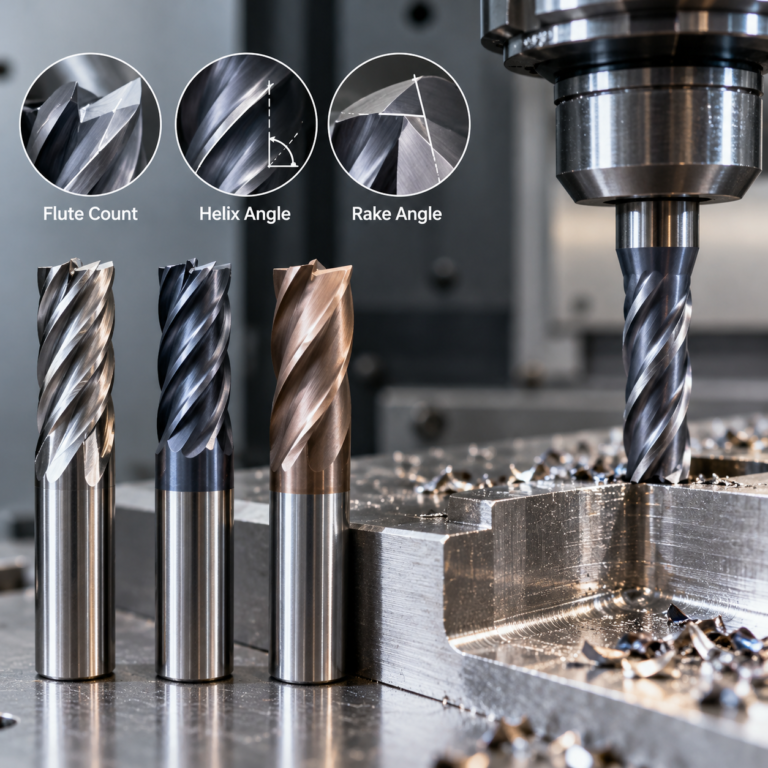
Flute count changes the cutter's physical structure. Two end mills with the same nominal diameter may behave differently because their flute depth, core, helix and cutting-edge preparation are not the same.
Cutting edges and flute valleys
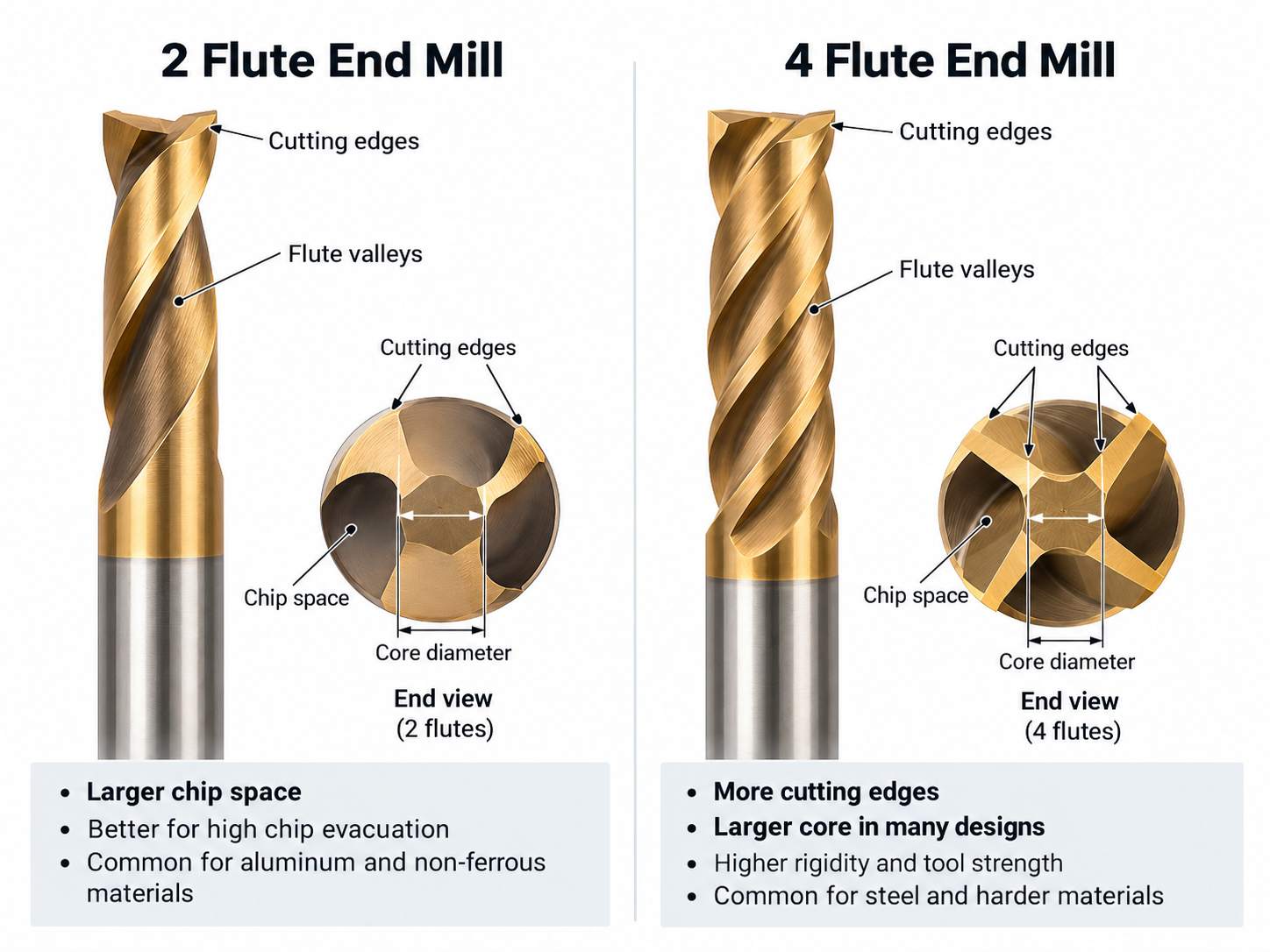
A 2-flute end mill has two cutting edges and two flute valleys. Common designs provide a large cross-sectional area for carrying chips away from the cut.
A 4-flute end mill has four cutting edges, with less available valley volume in many comparable designs. The smaller chip spaces can become a restriction when large amounts of material are removed in an enclosed slot.
Core diameter and stiffness
The core is the material remaining near the center of the end mill. Four-flute designs commonly use a larger core, which can improve bending and torsional stiffness.
However, flute count does not uniquely determine core diameter. A specially designed 2-flute tool may be more rigid than a long-reach or heavily relieved 4-flute tool.
Center-cutting geometry and entry
Both flute counts can be supplied with center-cutting end geometry, but this must be confirmed for the actual product.
Center-cutting does not automatically authorize unrestricted straight plunging. Ramping, helical entry and other entry strategies must remain within the cutter manufacturer's limits.
Selection principle: compare the exact tool geometry, not only the number of flutes. Chip volume, core diameter, cutting length and edge preparation can matter as much as edge count.
For a broader explanation of helix, pitch, rake angle and core diameter, see KXT's End Mill Geometry Guide .
2 Flute vs 4 Flute End Mill for Aluminum
Aluminum is a major application behind this comparison. Many aluminum alloys permit relatively high cutting speeds but can form large, adhesive chips. If chip evacuation fails, recutting and built-up edge may damage the cutter and the machined surface.
When a 2-flute end mill makes sense
- Full-width slots: a dedicated 2-flute aluminum cutter offers room for chips when engagement approaches the full tool diameter.
- Deep pockets with restricted evacuation: open flute valleys help chips leave the cutting zone, provided the coolant or air delivery and toolpath are suitable.
- Machine feed limitations: at the same RPM and fz, two cutting edges require a lower table feed than four. This may help when the machine cannot maintain a high programmed feed, although cutting forces and power still need to be checked.
Can a 4-flute carbide end mill cut aluminum?
Yes. A suitable aluminum-specific 4-flute end mill can work in light-radial side milling, profiling and finishing when the cutter has appropriate cutting edges, chip space and reliable evacuation.
A polished flute or coating qualified for aluminum may also be relevant. The fact that a cutter has four flutes is not by itself a reason to reject it.
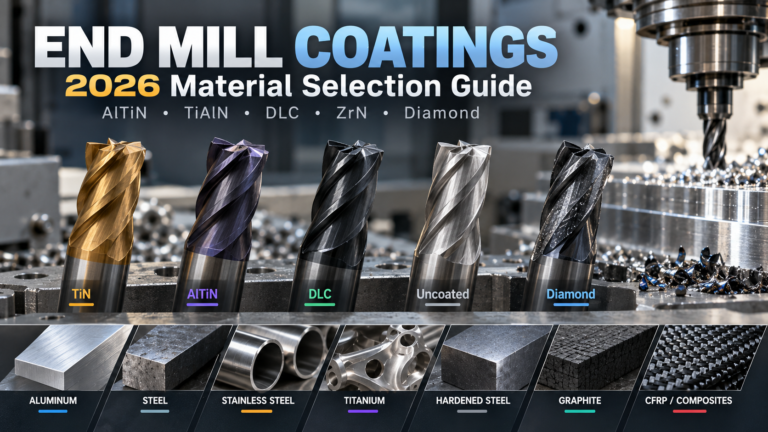
For coating and substrate selection, refer to the end mill coatings guide .
However, using a general-purpose 4-flute cutter in a deep, full-width aluminum slot can increase the risk of packed chips and built-up edge. Evaluate the toolmaker's intended operation rather than assuming all 4-flute designs behave the same way.
What about 6061 and 7075 aluminum?
Both alloys can be machined with properly selected carbide tools, but material condition, feature geometry, cutter diameter and radial engagement determine the setup.
A two-flute cutter may be a reasonable starting point for a full slot in 6061; a qualified 3- or 4-flute cutter may be considered for light-radial finishing in 7075.
These are application guidelines, not a guarantee that any particular tool will achieve a specified surface roughness or life.
Which Is Better for Steel, Stainless Steel and Hardened Steel?
Carbon and alloy steels
Four-flute solid carbide end mills are a common starting point for conventional steel milling.
A suitable 4-flute geometry offers more cutting edges and may offer a larger core than a comparable 2-flute tool. This can be useful for side milling, shoulder milling and finishing.
Steel slotting is different from aluminum slotting. Dedicated 4-flute carbide tools are used for many steel slots. Do not assume that steel full-width slotting automatically requires two flutes.
Select the cutter according to the chip size, tool geometry, axial depth, machine rigidity and recommended cutting data.
304 and 316 stainless steel
Austenitic stainless steels may work-harden when the cutting edge rubs or dwells. A suitable 4-flute or other application-specific design is often used for side milling and finishing.
Deep slots require careful verification of flute space, heat, entry strategy and chip evacuation. The correct slotting cutter could have two, three, four or another number of flutes depending on its design and the operation.
Reducing feed without checking chip thickness is not automatically a safe correction: an insufficient chip load can contribute to rubbing and work hardening.
Hardened tool and mold steels
Hard milling relies on appropriate edge strength, low runout, a rigid tool-holder assembly and controlled engagement.
Four-flute or higher-flute-count cutters are commonly used in suitable semi-finishing and finishing operations, but flute count alone cannot determine the correct tool for a given hardness or cutting strategy.
Slotting vs Side Milling vs Finishing
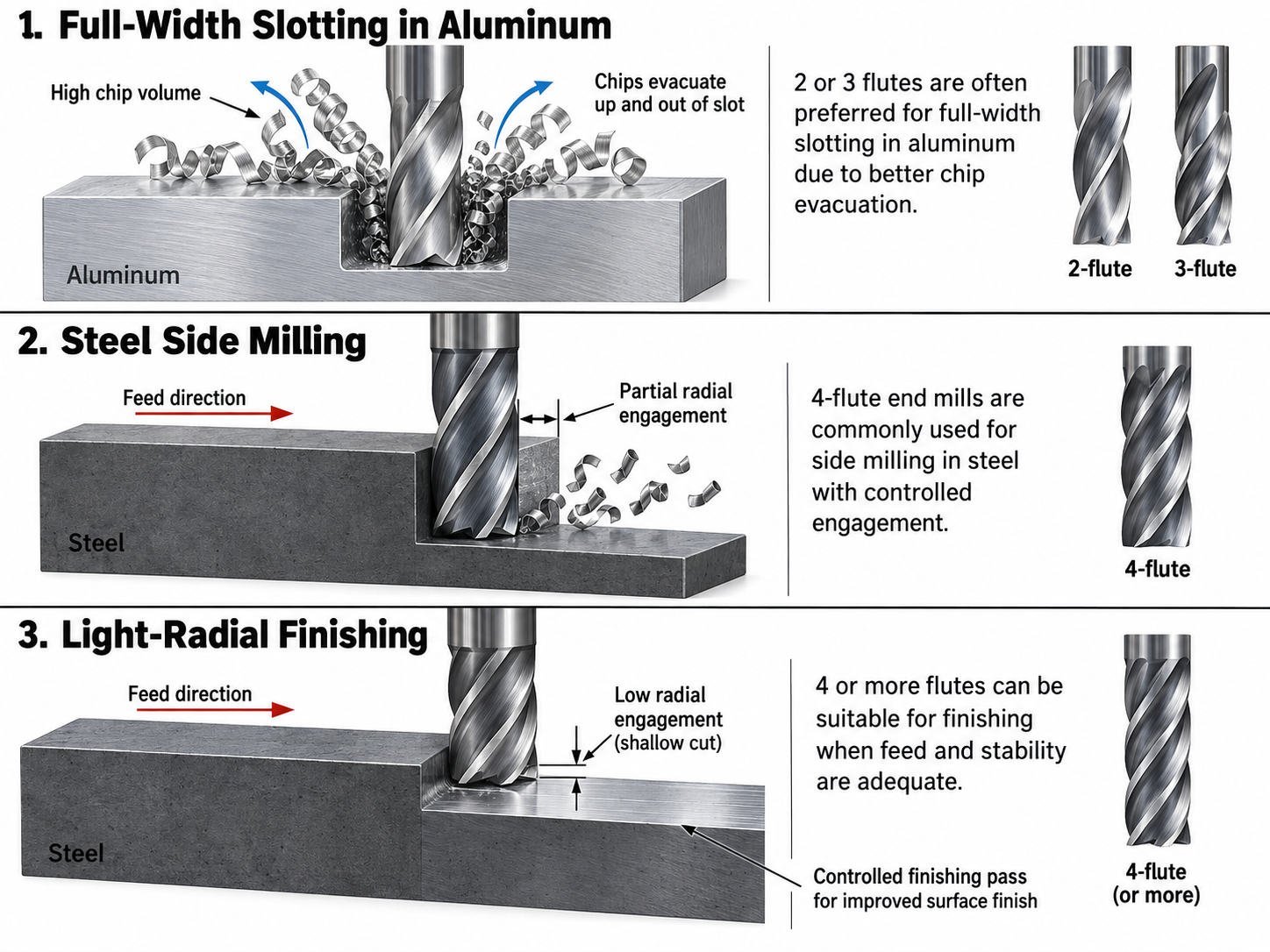
The operation often changes the preferred flute count as much as the workpiece material does. The most important distinction is between full-width engagement and controlled partial-width engagement.
| Operation | Important condition | Initial selection direction |
|---|---|---|
| Full-width slotting in aluminum | Large chip volume; approximately 100% radial engagement | Often 2 or 3 flutes with aluminum-specific geometry |
| Full-width slotting in steel | High engagement; cutter strength and chip control both matter | Dedicated steel-slotting tool; 4 flutes can be appropriate |
| Deep pocket roughing | Restricted chip escape and changing tool engagement | Choose from chip volume, toolpath and cutter series, not flute count alone |
| Side and shoulder milling | Controlled partial radial engagement | 4 flutes are often useful in steel; other counts may suit aluminum |
| Light-radial finishing | Lower chip volume; tight surface requirements | 4 or more flutes can be useful when the cutter and machine support the feed |
| Micro-diameter milling | Runout, deflection and edge strength can dominate | Use a purpose-designed tool; traditional large-tool rules may not apply |
Why radial engagement matters
In full-width slotting, chips have limited room to escape. As radial engagement becomes smaller, chip volume can become easier to manage, while cutter rigidity and the feed necessary to maintain chip thickness remain important.
At low radial engagement, the maximum chip thickness of a conventional peripheral milling cut can be lower than the programmed feed per tooth. This is known as radial chip thinning.
Correct compensation depends on the cutter profile, engagement and manufacturer limits. It should not be applied blindly to every toolpath.
Speeds and Feeds: 2 vs 4 Flutes
Changing the flute count changes the calculated table feed when spindle speed and feed per tooth remain constant.
For imperial units, use fz in inches/tooth to obtain inches/minute (IPM). For metric units, use mm/tooth to obtain mm/minute.
Worked example: identical RPM and fz
Assume 10,000 RPM and a programmed feed per tooth of 0.002 in/tooth. This is a mathematical comparison, not a cutting recommendation for a specific material or tool.
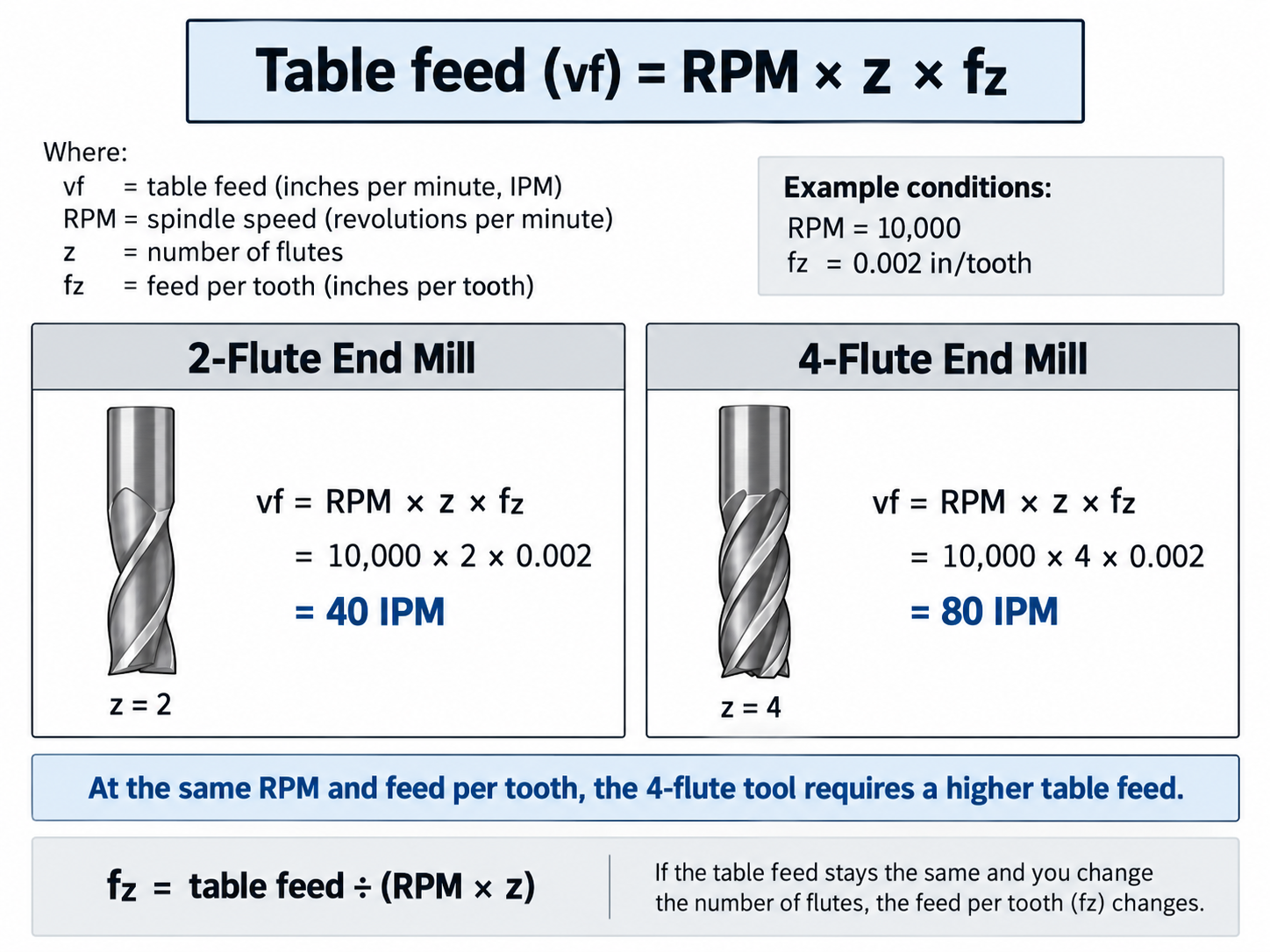
| Tool | Calculation | Table feed |
|---|---|---|
| 2-flute | 10,000 × 2 × 0.002 | 40 IPM |
| 4-flute | 10,000 × 4 × 0.002 | 80 IPM |
At the same RPM and fz, the 4-flute cutter requires twice the programmed table feed. This does not prove that it will machine twice as fast: the two cutters may require different chip loads, cutting speeds, radial engagements and toolpaths.
What happens if table feed stays the same?
If the programmed feed is kept at 40 IPM and spindle speed stays at 10,000 RPM, the 2-flute cutter has a calculated fz of 0.002 in/tooth, whereas the 4-flute cutter has a calculated fz of 0.001 in/tooth.
Under some conditions, that lower value could lead to rubbing rather than effective chip formation.
Recalculate feed per tooth whenever you change flute count. Then verify that the selected tool can accommodate the resulting load and evacuate its chips.
Machine feed capability matters, but spindle power, torque, tool stiffness and part rigidity matter as well.
Spindle speed is a separate calculation
In the metric formula, Vc is cutting speed in m/min and D is the relevant cutter diameter in mm. In conventional peripheral milling, nominal diameter is normally used. Profiled tools may require an effective cutting diameter.
Use the selected cutter manufacturer's recommended cutting-speed and feed-per-tooth values. The examples above show the mathematical effect of flute count only.
Tool Life, Rigidity and Surface Finish
Does a 4-flute end mill last longer?
Not necessarily. More cutting edges can distribute engagement differently and may improve productivity in a suitable stable cut, but tool life also depends on per-tooth load, coating, cutting-edge preparation, runout, heat and chip recutting.
In a slot with poor evacuation, a 4-flute tool may wear or fail earlier than a suitable lower-flute-count design.
Does a 4-flute end mill have greater rigidity?
A conventional 4-flute design often has a larger core than a comparable 2-flute cutter, which can increase stiffness.
However, core diameter, cutting length, reach and overall tool geometry must be compared directly. Shortening unnecessary overhang is frequently more useful than changing flute count without addressing the setup.
Which produces a better surface finish?
There is no universal winner. At equal RPM and table feed, a 4-flute cutter has a lower nominal feed per tooth, but the resulting surface depends on the engagement, geometry, radial runout, edge condition, deflection, built-up edge and vibration.
A well-matched 2-flute tool can produce a better surface than an unsuitable 4-flute tool.
For a meaningful comparison, measure surface roughness, flank or corner wear, dimensional error and cutting time under documented conditions, rather than judging by flute count alone.
When Should You Choose 3 or More Flutes Instead?
The decision is not always limited to two or four flutes. Three-flute tools are common in aluminum machining because they can offer a useful balance of chip space, cutting edges and core strength.
They can be appropriate for many pocketing, profiling and finishing operations when the tool geometry and parameters are qualified.
In steel, stainless and hard-milling applications, purpose-designed tools with five or more flutes may be appropriate, particularly with controlled radial engagement.
At miniature diameters, stiffness and edge geometry can become more important than the traditional rule of using the fewest flutes for slotting.
The correct question is not only "2 or 4 flutes?" but also "which tool design gives this operation enough chip room, edge strength and stable feed?"
Practical Tool Selection Examples
The following are illustrative selection scenarios, not KXT test results. The final choice needs actual tool and process data.
Example 1 — Full-width slot in 6061-T6 aluminum
Chip evacuation is the main concern. A dedicated 2-flute aluminum square end mill with polished flutes is a reasonable starting candidate. A qualified 3-flute design may also work.
Verify the slot depth, feed, coolant or air blast and the cutter's recommended engagement.
Example 2 — Light-radial finishing in 7075 aluminum
With chip volume controlled, an aluminum-specific 3- or 4-flute cutter may be evaluated for finishing.
Confirm that edge geometry, coating, runout and the required table feed are compatible with the target surface finish. No result is guaranteed solely by selecting four flutes.
Example 3 — Side milling 4140 alloy steel
For a rigid setup and partial-width engagement, a suitable 4-flute carbide end mill is a common starting point.
The workpiece condition and hardness, axial engagement, cutter length and manufacturer's cutting data remain essential.
Example 4 — Full-width slot in steel
Unlike the traditional aluminum example, a dedicated 4-flute steel-slotting end mill can be appropriate.
Check chip evacuation, engagement, tool strength and coolant before selecting the cutter. A lower-flute-count alternative should be considered based on the actual process, not a blanket rule.
Example 5 — Limited machine feed capability
If a four-flute tool's recommended fz at the chosen RPM requires more table feed than the machine can maintain, a two-flute design may be easier to run at an appropriate nominal chip load.
This does not automatically make it lower-power or more productive; recalculate all cutting conditions and check machine torque and process stability.
Common Mistakes and Selection Checklist
Common mistakes
- Assuming every 4-flute end mill will clog in aluminum regardless of tool design and engagement.
- Assuming every steel or stainless slot should be milled with two flutes.
- Leaving table feed unchanged when switching between two and four flutes without recalculating fz.
- Using very low chip thickness, allowing rubbing or work hardening.
- Ignoring radial engagement and chip-thinning effects.
- Comparing flute counts while changing the cutter diameter, reach, coating and toolholder at the same time.
- Using excessive overhang or failing to measure runout near the cutting end.
- Treating a theoretical feed calculation as proof of actual tool life or cycle-time improvement.
Selection checklist before production
- Confirm the exact material grade, hardness and heat-treatment condition.
- Identify the operation: full slot, pocket, side milling, contouring or finishing.
- Record radial engagement (ae), axial engagement (ap) and required tool reach.
- Check the actual cutter's flute geometry, core, edge preparation and coating.
- Verify RPM, calculated fz and achievable table feed.
- Confirm chip evacuation, coolant delivery, holder, runout and minimum practical overhang.
- Inspect the first part for finish, dimensions, chip formation and cutting-edge wear.
Frequently Asked Questions
Is a 2-flute or 4-flute end mill better?
Neither is universally better. Two flutes generally give more chip space in comparable conventional designs, while four flutes give more cutting edges and often a larger core. Material, engagement, cutter geometry and machine capability determine the better option.
Can I use a 4-flute end mill on aluminum?
Yes, when the cutter is suitable for aluminum and the operation provides adequate chip evacuation. Light-radial side milling and finishing can be appropriate. Deep full-width slotting calls for special attention to chip packing and is often better served by a purpose-designed 2- or 3-flute tool.
Why are 2-flute end mills commonly used for aluminum?
The larger valleys of conventional 2-flute designs help move bulky aluminum chips out of the cut, especially during slots and heavy chip-generation operations. This is an application trend, not a universal rule.
Can a 2-flute end mill cut steel?
Yes, if its substrate, geometry, coating and cutting conditions are designed for steel. A four-flute design remains a common starting point for many conventional steel side-milling and finishing applications.
Is a 2-flute or 4-flute end mill better for slotting?
It depends strongly on the material. Aluminum full-width slots often favor two or three flutes for evacuation. Steel slots can be machined with dedicated four-flute designs. Use the cutter manufacturer's slotting data and check chip removal.
How many flutes should I use for stainless steel?
Application-specific tools with four or more flutes are commonly used for side milling and finishing. For deep slotting, prioritize a qualified design with sufficient chip space and stable chip formation rather than choosing a fixed flute count from a general rule.
Do four flutes always give a better surface finish?
No. Surface finish depends on cutting geometry, feed per tooth, runout, deflection, wear, built-up edge and toolpath. More flutes may help in suitable conditions but cannot correct a poor setup.
Does a 4-flute end mill require twice the feed rate?
Only in the theoretical comparison where RPM and programmed feed per tooth are identical. In actual machining, the appropriate fz and other cutting limits may differ between the two tools.
Should I use three or four flutes for aluminum?
Three-flute aluminum-specific cutters are common for a broad range of operations. A qualified 4-flute cutter can be suitable for controlled light-radial milling, while lower flute counts are often preferred where chip volume is high.
Related End Mill Guides and KXT Tools
This comparison focuses specifically on flute count and the choice between two and four cutting edges. For the underlying geometry, cutter styles and common tool failures, use the related KXT guides below.
The KXT solid end mill catalog currently includes 2-flute ball nose and 4-flute square end mill families. These are different tool profiles and should not be treated as a controlled two-versus-four-flute performance comparison.
Ask KXT About Your Milling Application
KXT / Taizhou Tengli Tools manufactures CNC cutting tools for precision milling, mold machining and related applications.
For tool selection support, provide the workpiece grade and hardness, cutter dimensions, milling operation, required finish and any current cutting data or tool-life issue.
Contact the KXT Technical Team Browse Solid End Mills
Tool selection and machining parameters require confirmation against the actual cutter and machining conditions.
Technical References
- Harvey Performance — Why Flute Count Matters . Flute space, core strength and the relationship between flute count and material.
- Harvey Performance — Attacking Aluminum: A Machining Guide . Aluminum-specific flute and geometry considerations.
- Harvey Performance — Speeds and Feeds 101 . Feed-per-tooth, chip load and milling conditions.
- KXT — End Mill Geometry Explained . Additional cutting-geometry explanations.
This article provides technical selection guidance, not universal cutting values or controlled comparison-test results. Use product-specific cutting data and verify final settings in the machining application.