
End Mill Coatings for CNC Milling | 2026 Material Selection Guide
End Mill Coatings for CNC Milling: 2026 Material Selection Guide
Quick Answer: Best End Mill Coating by Material
The best end mill coating is the one that controls the dominant failure mode without sacrificing the edge shape the cut needs. Use polished uncoated carbide, TiB2, ZrN or a suitable DLC coating for aluminum and other non-ferrous alloys. Use TiAlN, AlTiN, AlCrN or a modern nanocomposite coating when heat and wear dominate in steels, stainless steel, titanium, nickel alloys or hardened steel. Use CVD diamond for graphite, CFRP, ceramics in the green state and other highly abrasive non-ferrous materials. Do not choose by coating color, hardness or name alone.
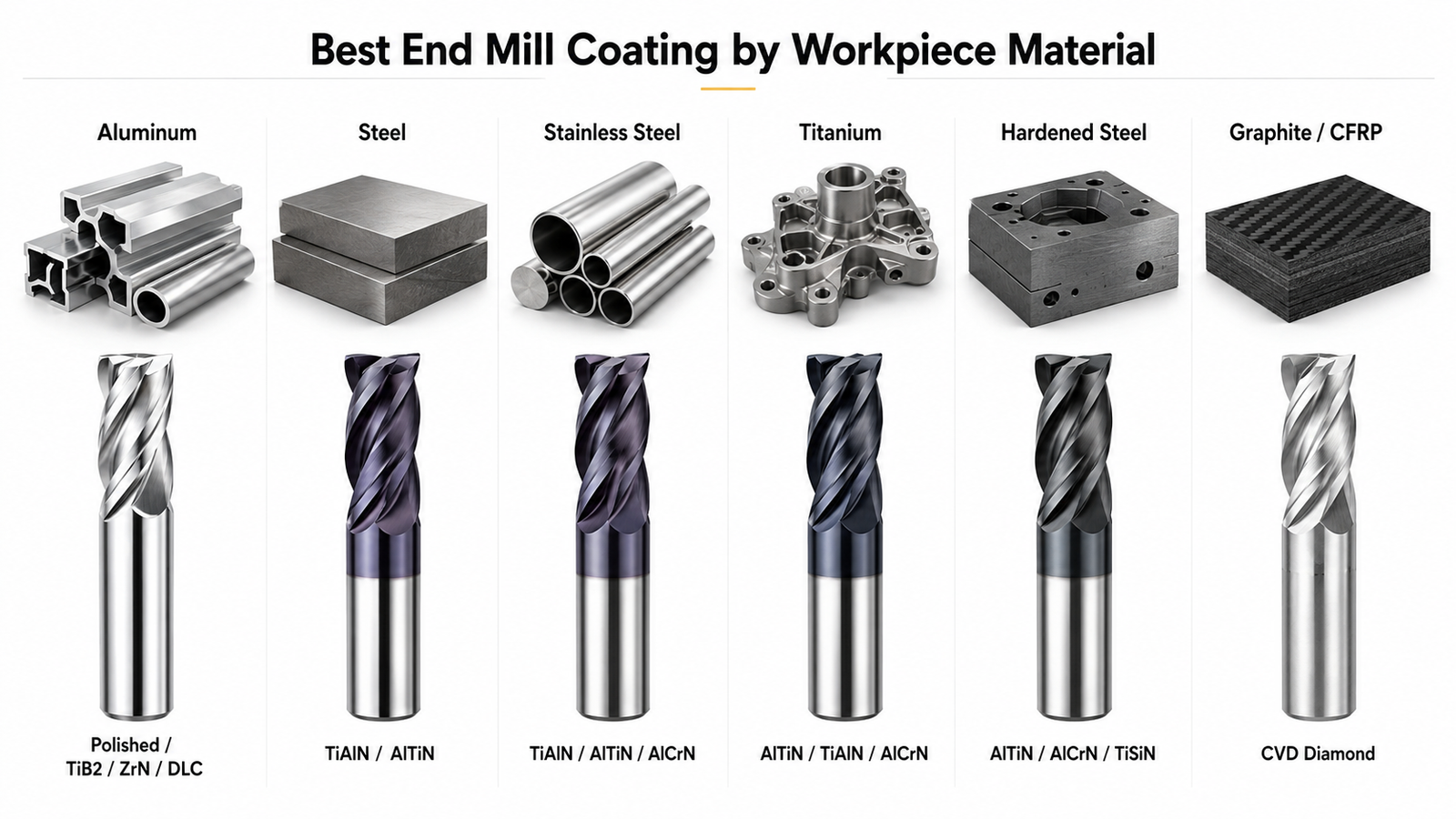
End mill coatings are thin engineered surfaces placed over a carbide substrate. They can reduce friction, slow abrasive wear, resist oxidation and change how heat moves through the cutting zone. They cannot correct the wrong flute geometry, poor chip evacuation, excessive runout, a weak setup or an unsuitable cutting speed.
That distinction matters. Many carbide end mill coating guides match one coating to one material and stop there. Real CNC milling is less tidy. The same 6061 aluminum may need polished uncoated carbide in a deep slot, TiB2 in a long production run, or CVD diamond only when abrasive constituents make wear the limiting cost. The correct answer depends on the alloy, operation, engagement, coolant strategy, tool diameter, machine rigidity and required finish.
End Mill Coating Selector: A Six-Step Method
Start with the workpiece, but do not end there. A useful end mill coating selector follows the order below.
- Identify the exact material. Record the alloy or grade, hardness, heat treatment, casting condition and abrasive content. “Aluminum,” “stainless” and “tool steel” are not precise enough.
- Identify the operation. Full-width slotting, adaptive roughing, finishing, drilling entry and deep pocketing create different chip loads, heat cycles and evacuation demands.
- Name the current failure mode. Look for built-up edge, uniform flank wear, crater wear, edge chipping, thermal cracks, coating delamination, excessive burrs or a finish problem.
- Protect the required edge geometry. A thick, wear-resistant layer can be helpful in abrasive cutting, but it can round a micro-tool or finishing edge. Edge sharpness can matter more than maximum coating hardness.
- Match the thermal strategy. Decide whether the process will run dry, with minimum-quantity lubrication, air blast, mist, flood coolant or through-tool coolant. Repeated heating and quenching can punish a coating differently from steady dry cutting.
- Check the complete tool system. Substrate grade, flute shape, edge preparation, coating architecture, holder, runout, overhang and toolpath all influence the result.
Seco describes a milling grade as a balance between carbide, coating and geometry. Its published guidance also shows that tougher grades and sharper geometries respond differently to mechanical shock, thermal shock and wear. That same systems view applies to solid-carbide end mills: coating selection should never be separated from geometry and substrate.5
End Mill Coating Chart by Workpiece Material
| Workpiece | Practical first choice | Alternative | Main selection reason | Important caution |
|---|---|---|---|---|
| Wrought aluminum, low silicon | Polished uncoated carbide or TiB2 | ZrN or an aluminum-qualified DLC | Sharp edge, low aluminum affinity and clean chip flow | Do not assume every DLC product has the same chemistry or temperature limit |
| Cast or abrasive aluminum | ZrN, DLC or diamond, selected by silicon content and production volume | TiB2 for less-abrasive alloys | Balance anti-adhesion with abrasive wear resistance | A thick diamond layer may alter edge radius on small tools |
| Copper, brass and bronze | ZrN, DLC or amorphous diamond | Polished uncoated carbide | Lubricity, edge sharpness and resistance to adhesion or abrasion | Match coating to whether the alloy is gummy or abrasive |
| Carbon and alloy steel | TiAlN or AlTiN | AlCrN; TiN for moderate general-purpose work | Hot hardness, oxidation resistance and flank-wear control | Confirm wet, dry and interrupted-cut suitability |
| Stainless steel | TiAlN, AlTiN or AlCrN | TiSiN or another supplier-qualified nanocomposite | Heat resistance with a smooth surface and a tough cutting edge | Coating will not prevent work hardening caused by rubbing |
| Cast iron | AlTiN or AlCrN | Application-specific TiAlN | Abrasive wear and elevated cutting temperature | Graphitic cast iron is not the same application as machining pure graphite |
| Titanium alloys | Application-specific AlTiN, TiAlN or AlCrN | TiSiN-based premium coating | Heat resistance, adhesion control and edge integrity | Use a titanium-specific geometry and dependable coolant delivery |
| Nickel-based superalloys | TiAlN, AlTiN, AlCrN or TiSiN-based coating | Supplier-specific multilayer or nanocomposite | Hot hardness and resistance to oxidation and notch wear | Published coating names do not reveal substrate toughness or edge preparation |
| Hardened steel | AlTiN, AlCrN or TiSiN-based coating | Supplier-specific hard-milling nanocomposite | Hot hardness, abrasive wear resistance and thermal stability | Hardness range, toolpath and machine rigidity must be specified |
| Graphite, CFRP and abrasive composites | CVD diamond | Amorphous diamond or PCD where the geometry permits | Extreme abrasion resistance | Avoid diamond on ferrous workpieces at cutting temperature |
| Unfilled plastics | Polished uncoated carbide | DLC when validated for the polymer and process | Sharp cutting and low friction | Heat evacuation and edge geometry often matter more than hardness |
| Glass-filled or carbon-filled plastics | Diamond coating | Wear-resistant DLC for selected applications | Filler abrasion | Confirm edge radius, surface finish and delamination risk |
Important: A material matrix gives a defensible starting point, not a guaranteed winner. Two coatings with the same label can have different elemental ratios, layer structures, deposition methods, thicknesses, residual stress, surface finish and adhesion.
CNC Milling Coatings: TiN, TiCN, AlTiN, DLC and Diamond
| Coating | Useful strengths | Typical starting applications | Do not choose it when |
|---|---|---|---|
| TiN | General wear resistance and a familiar baseline coating | Moderate-speed machining of steels and general ferrous work | High cutting temperature or severe abrasion is the main limit |
| TiCN | Higher hardness and abrasive wear resistance than basic TiN in many product systems | Steels, stainless steels and abrasive work at controlled temperatures | The application produces sustained high heat beyond the supplier’s recommended range |
| TiAlN | Balanced hot hardness, wear resistance and thermal stability | Steels, stainless steel, cast iron and difficult ferrous applications | The workpiece is aluminum and adhesion is likely |
| AlTiN | High-temperature and oxidation resistance in many aluminum-rich nitride systems | Alloy steel, tool steel, stainless, titanium, nickel alloys and hard milling | The workpiece is aluminum or the cut requires an extremely keen, unrounded edge |
| AlCrN | Thermal stability, oxidation resistance and useful performance in demanding wet or dry cycles | Steel, stainless, cast iron, titanium and hardened materials | The supplier does not approve the exact alloy, operation or coolant cycle |
| TiSiN or AlTiSiN | Very high hot hardness in modern nanocomposite systems | Hardened steel, difficult alloys and rigid high-speed finishing | The setup is unstable or the cutting edge needs more toughness than hardness |
| ZrN | Lubricity and wear resistance for non-ferrous materials | Aluminum, copper, brass and bronze, including some abrasive alloys | Maximum abrasion resistance in graphite or composites is required |
| TiB2 | Low chemical affinity to aluminum and good resistance to built-up edge | Aluminum and magnesium alloys | The alloy is so abrasive that diamond becomes economically justified |
| DLC | Low friction and strong anti-adhesion behavior in suitable formulations | Aluminum and other non-ferrous materials; selected polymers | High-temperature ferrous cutting exceeds the coating’s design window |
| Amorphous diamond | Thin carbon-based wear layer that can retain a sharper edge than thicker CVD diamond | Abrasive aluminum, copper, graphite, composites and non-ferrous materials | Long-run abrasion demands a thicker crystalline diamond layer |
| CVD diamond | Exceptional abrasive wear resistance | Graphite, CFRP, green ceramics, green carbide and abrasive non-ferrous materials | The workpiece is ferrous or the coating thickness compromises a critical micro-edge |
Harvey Tool publishes separate coating families for ferrous and non-ferrous materials. Its data identifies AlTiN as a ferrous and exotic-material coating, TiB2 and ZrN as non-ferrous options, and amorphous or CVD diamond for abrasive non-ferrous and non-metallic work. The company also warns that its figures are general comparison guidance because sources and test methods vary.1 That warning is worth keeping: a single universal temperature or hardness ranking is not reliable across brands.
Best End Mill Coating for Aluminum
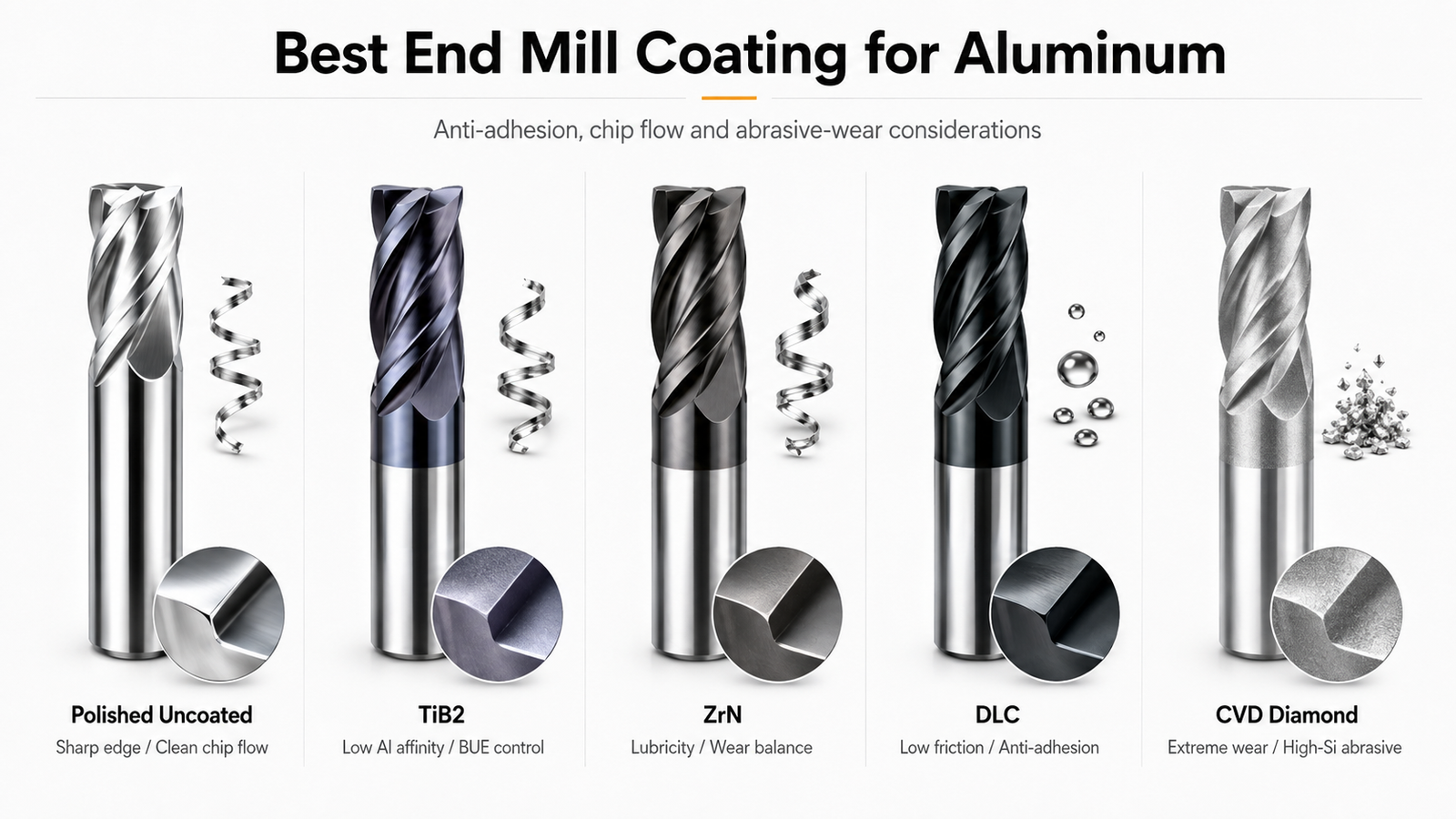
For most wrought aluminum machining, begin with a sharp, highly polished uncoated carbide end mill or a TiB2-coated tool designed for aluminum. Move to ZrN, DLC or diamond only when the alloy, wear pattern and production economics justify the change.
Why polished uncoated carbide still works
Aluminum forms large, ductile chips and can weld to the cutting edge. A polished flute, generous chip space and keen rake help the chip leave before it is recut. An uncoated tool also preserves the ground edge without adding coating thickness. It is often a strong option for prototypes, low-volume work, deep slots and small tools where edge sharpness is critical.
When to choose a TiB2 or ZrN end mill for aluminum
TiB2 is a practical production coating for aluminum because its low affinity to aluminum helps reduce built-up edge and chip packing. Harvey Tool recommends it for aluminum and magnesium alloys, while noting that very abrasive alloy variants may need another solution.1
ZrN is a broader non-ferrous option. It adds lubricity and wear resistance and can be useful in abrasive aluminum, copper, brass and bronze. It is often easier to justify than diamond when the job needs more wear resistance than uncoated carbide but does not yet support the cost of a diamond-coated end mill.
When diamond becomes the better economic choice
High-silicon aluminum and metal-matrix composites can wear an ordinary edge quickly. CVD diamond can deliver the abrasion resistance needed for long runs. The trade-off is a thicker deposited layer and a less keen effective edge. In thin walls, micro tools or fine finishing, compare a thin amorphous diamond option with CVD diamond rather than assuming the hardest coating will produce the best part.
Can you use TiAlN on aluminum? Usually, no. Aluminum-bearing nitride coatings such as TiAlN and AlTiN can have chemical affinity with an aluminum workpiece, encouraging adhesion and built-up edge. Harvey Tool explicitly marks its AlTiN and AlTiN Nano systems as not recommended for aluminum alloys.1 A toolmaker may offer a specially engineered exception, but it should be validated as a complete product rather than selected from the acronym alone.
DLC Coated End Mill: Best Applications and Limits
A DLC coated end mill is a strong candidate when friction, aluminum adhesion and built-up edge are limiting an otherwise stable non-ferrous milling process. OSG positions its DLC-coated carbide end mills for non-ferrous materials, including aluminum alloys, with emphasis on lubricity, welding resistance, cutting sharpness, chip evacuation and burr control.3
DLC means diamond-like carbon. It is a family of carbon-based coatings, not one universal specification and not the same as crystalline CVD diamond. DLC products can differ in carbon bonding, dopants, interlayers, thickness, hardness, friction and maximum service temperature. Ask the supplier for the exact DLC type and approved application range.
DLC vs ZrN for aluminum
Choose between DLC and ZrN by looking at the current wear pattern. DLC is attractive when adhesion and friction dominate. ZrN is a practical general-purpose non-ferrous coating when moderate abrasive wear and lubricity both matter. Run a controlled comparison when either option appears suitable because flute polish, edge radius and coating thickness can change the result as much as the coating name.
When not to use a DLC coated end mill
Do not use a low-temperature DLC formulation for a hot ferrous application unless the coating supplier explicitly approves it. Do not choose DLC only because its catalog friction value is low; that value depends on the test pair and test conditions. For graphite, CFRP and other severely abrasive materials, crystalline diamond may provide more useful wear volume.
AlTiN vs TiAlN: How TiN and TiCN Compare
Composition, naming and performance differences
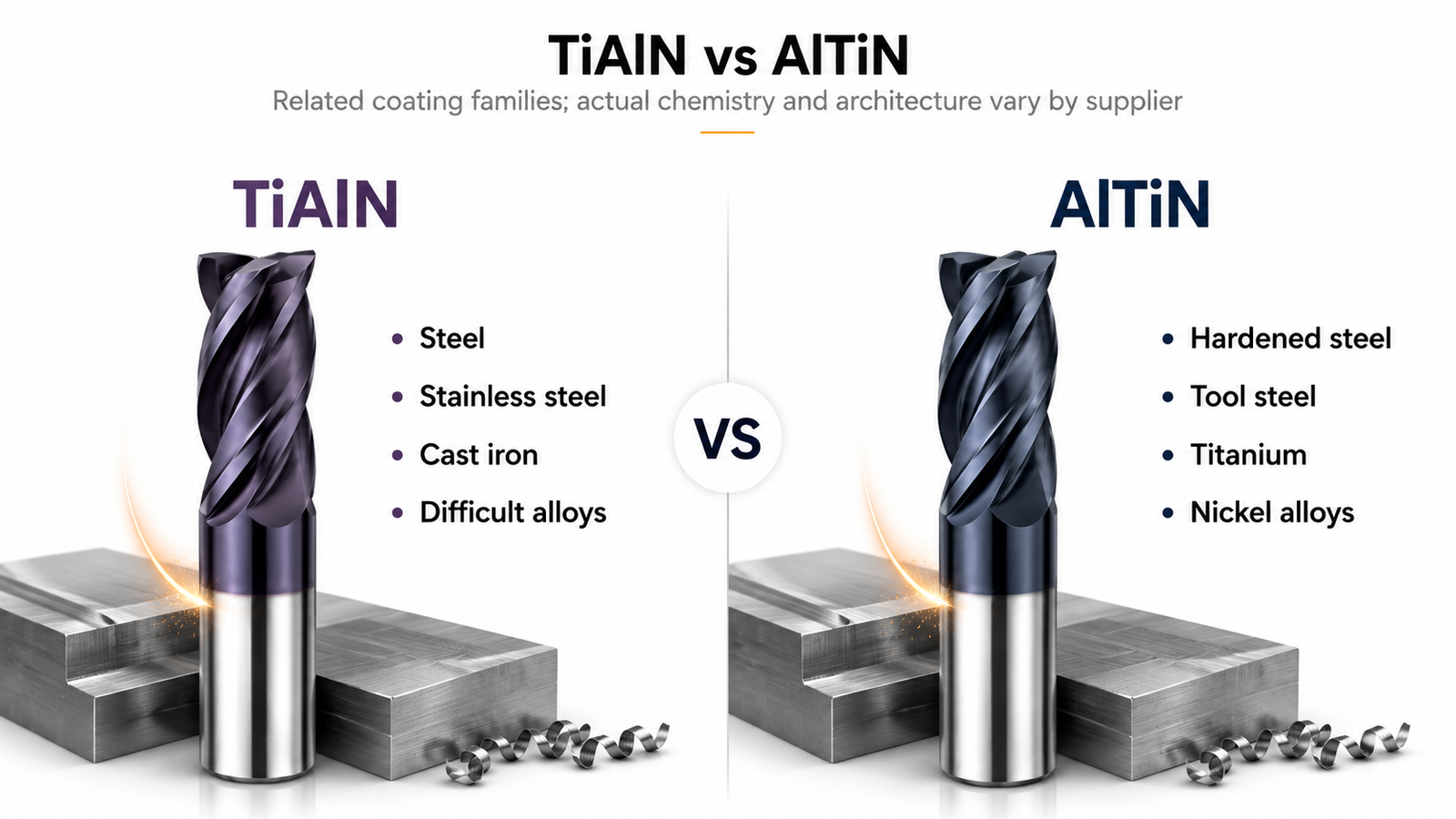
AlTiN and TiAlN are related aluminum-titanium nitride coating families. In general usage, AlTiN often indicates an aluminum-rich composition chosen for oxidation resistance and hot performance, while TiAlN often indicates a titanium-richer balance with a different combination of hardness, friction and toughness. Oerlikon Balzers separates TiAlN-based and AlTiN-based products and describes AlTiN as the more oxidation-resistant, higher-temperature option in that portfolio.4
Do not treat that wording as a universal chemical standard. Suppliers may use different atomic ratios, interlayers, multilayers, nanostructures and brand names under the same short label. For a valid AlTiN vs TiAlN comparison, request the actual coating specification and compare tools with the same carbide, geometry, edge preparation and test conditions.
| Question | TiN | TiCN | TiAlN | AlTiN |
|---|---|---|---|---|
| Best role | General-purpose baseline | Harder, wear-focused step beyond TiN | Hot, demanding ferrous machining | High-temperature and oxidation-focused machining |
| Typical workpieces | General steels | Steels and selected stainless applications | Steel, stainless, cast iron and difficult alloys | Steel, stainless, titanium, nickel alloys and hard materials |
| Thermal capability | Lowest of these four in most commercial systems | Usually below TiAlN and AlTiN | High | High to very high, depending on composition |
| Aluminum workpiece | Not the preferred modern choice | Not the preferred choice | Generally avoid | Generally avoid |
| Main purchasing question | Is a basic coating enough? | Can cutting temperature stay controlled? | What is the actual composition and layer design? | What are the aluminum ratio, edge prep and approved coolant conditions? |
TiCN vs TiN
TiCN is commonly selected when abrasive wear exceeds what a basic TiN tool can tolerate. Oerlikon’s published coating matrix lists TiCN with higher hardness than TiN in that product family, but also with a lower maximum working temperature.6 That is the real trade-off: choose TiCN for wear resistance under controlled thermal conditions, and do not assume that a harder coating automatically survives a hotter cut.
TiN vs TiAlN
TiN remains useful as a general-purpose coating and a familiar production baseline. A TiAlN coated end mill is usually the stronger starting point when cutting speed, engagement or workpiece strength creates sustained heat. TiAlN’s advantage is not simply “more hardness.” Its value is the way a correctly engineered coating retains useful properties at elevated cutting temperature.
Best End Mill Coating for Stainless Steel
Stainless steel combines toughness, poor thermal conductivity and a tendency to work harden. TiAlN, AlTiN and AlCrN are common starting families because they resist heat and wear. The coating must work with a sharp, supported edge that maintains chip thickness. If the tool dwells or rubs, the next pass meets a harder surface, and even a premium coating can fail quickly.
- Use a geometry designed for stainless, not a generic steel end mill chosen only by coating.
- Keep feed per tooth high enough to cut beneath the work-hardened layer.
- Use stable radial engagement and avoid abrupt toolpath changes.
- Deliver coolant consistently when the selected tool and process call for it.
- Inspect for notch wear near the axial depth-of-cut line and adjust before the edge breaks down.
Best End Mill Coating for Titanium
Titanium keeps heat close to the cutting edge and can adhere to the tool. Application-specific AlTiN, TiAlN, AlCrN and TiSiN-based systems are available, but the winning combination also needs a tough carbide substrate, suitable rake, controlled edge preparation and reliable coolant access. Oerlikon identifies titanium, nickel-based alloys, stainless and hardened steel as demanding applications for its layered AlTiN and TiSiXN coating system.7
Do not copy the speed used for alloy steel because both tools happen to be AlTiN. Reduce unnecessary radial engagement, maintain chip thickness, limit runout and prevent chips from returning to the cut. In titanium milling, evacuation and temperature control often decide whether the coating has a chance to work.
Best End Mill Coating for Hardened Steel
For hardened steel, the exact hardness range must be part of the selection. A tool for 42 HRC pre-hardened steel is not automatically the right tool for finishing 62 HRC die steel. AlTiN, AlCrN and TiSiN-based nanocomposites are common families because they combine hot hardness and abrasive wear resistance. Harvey Tool, for example, assigns its AlTiN Nano and Ti Hard Nano offerings to hardened-steel ranges in its current catalog.2
Use the shortest practical reach, a rigid holder, controlled runout and a toolpath that avoids sudden engagement. If the edge chips before measurable flank wear develops, a harder coating is unlikely to be the first solution. Check substrate toughness, edge hone, overhang and radial engagement.
Where an AlCrN coating end mill fits
An AlCrN coating end mill is often considered when oxidation resistance, hot hardness and thermal-cycle stability are important. It can be a strong candidate for steels, stainless, cast iron, titanium and hardened materials. Still, AlCrN is a family, not a complete tool specification. Ask whether the product is optimized for continuous dry heat, coolant, interrupted engagement, roughing or finishing.
Diamond Coated End Mills for Graphite and Composites
A diamond coated end mill is chosen for abrasion resistance, not because diamond is universally superior. Graphite, carbon-fiber composites, glass-filled polymers, green ceramics and high-silicon aluminum can remove ordinary carbide and nitride coatings rapidly. CVD diamond places a crystalline diamond layer on the carbide and is a strong production choice when wear cost dominates.
Graphite end mill coating
For graphite, CVD diamond is usually the first coating family to evaluate. Graphite produces fine, abrasive particles and normally runs dry with effective dust extraction. A thicker diamond layer can extend wear life, while a thinner layer can preserve a keener edge for small features and better finish. Tool diameter, corner radius, surface tolerance and feature size should determine the thickness choice.
Amorphous diamond, CVD diamond and PCD are not the same
- Amorphous diamond is a thin carbon-based coating that can preserve a sharper edge. It is useful when non-ferrous abrasion and finish must be balanced.
- CVD diamond is a crystalline deposited layer. It normally offers much greater wear volume and is suited to long-running abrasive applications.
- PCD is a polycrystalline diamond cutting material attached to a tool body rather than a conventional thin coating. It offers excellent wear life but limits the geometries that can be produced economically.
Harvey Tool publishes separate thickness ranges and application guidance for amorphous diamond, thin and standard CVD diamond, and PCD. Its data shows why the word “diamond” alone is not enough for tool selection.1
Do not use diamond as a general coating for steel. At cutting temperature, chemical interaction between diamond carbon and ferrous workpieces can cause rapid wear. For steel, stainless and cast iron, select a nitride or chromium-based coating designed for the application.
PVD vs CVD Coatings on End Mills
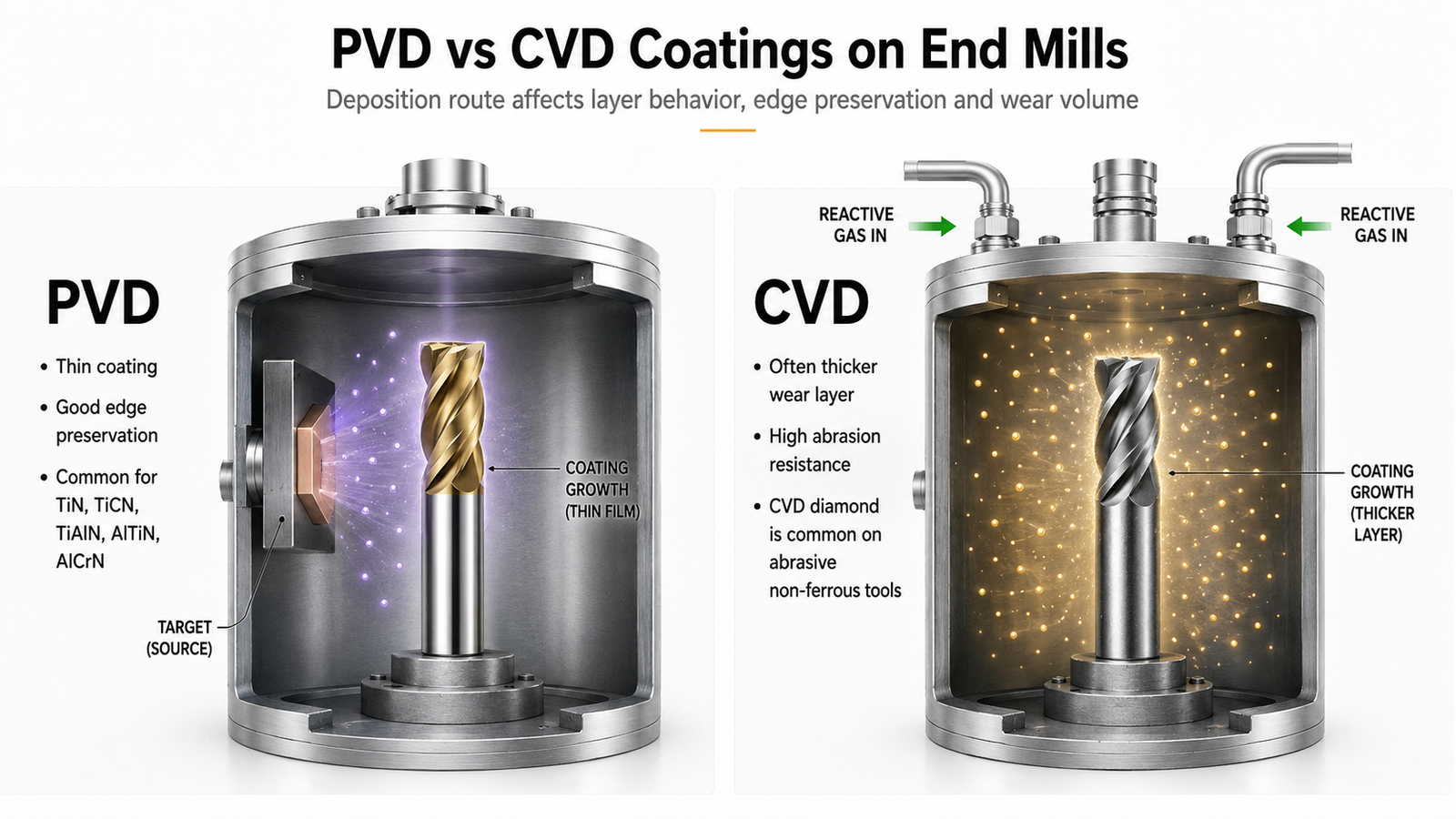
PVD and CVD describe deposition routes, not one fixed coating chemistry. Physical vapor deposition vaporizes source material in a vacuum and forms a relatively thin layer. Chemical vapor deposition uses reacting gases in a heated chamber to form the layer. Seco’s general milling guidance describes PVD layers up to roughly 4 to 5 micrometers and CVD layers at roughly 7 micrometers or more for its milling-grade context.5 Those figures should not be copied as universal end-mill limits.
| Factor | PVD starting point | CVD starting point |
|---|---|---|
| Typical layer behavior | Thinner layer and better preservation of a keen edge | Thicker wear layer and strong heat or abrasion resistance, depending on chemistry |
| Common solid-carbide end mill use | TiN, TiCN, TiAlN, AlTiN, AlCrN, TiB2 and many nanocomposites | Most visibly associated with crystalline diamond on abrasive non-ferrous tools |
| Edge consideration | Good fit for sharp cutting edges and small tools | Thickness may round the effective edge and must match feature size |
| Selection question | Does the layer provide enough wear and heat resistance? | Does the added wear life justify the edge-radius and cost trade-off? |
Do not reject or approve a tool only because it is PVD or CVD. Ask for the chemistry, architecture, thickness, edge preparation, substrate, surface treatment after coating and approved application window.
Select CNC Milling Coatings by Failure Mode
The most useful coating decision begins at the worn tool. Clean it, inspect every flute under consistent magnification and identify what happened first.
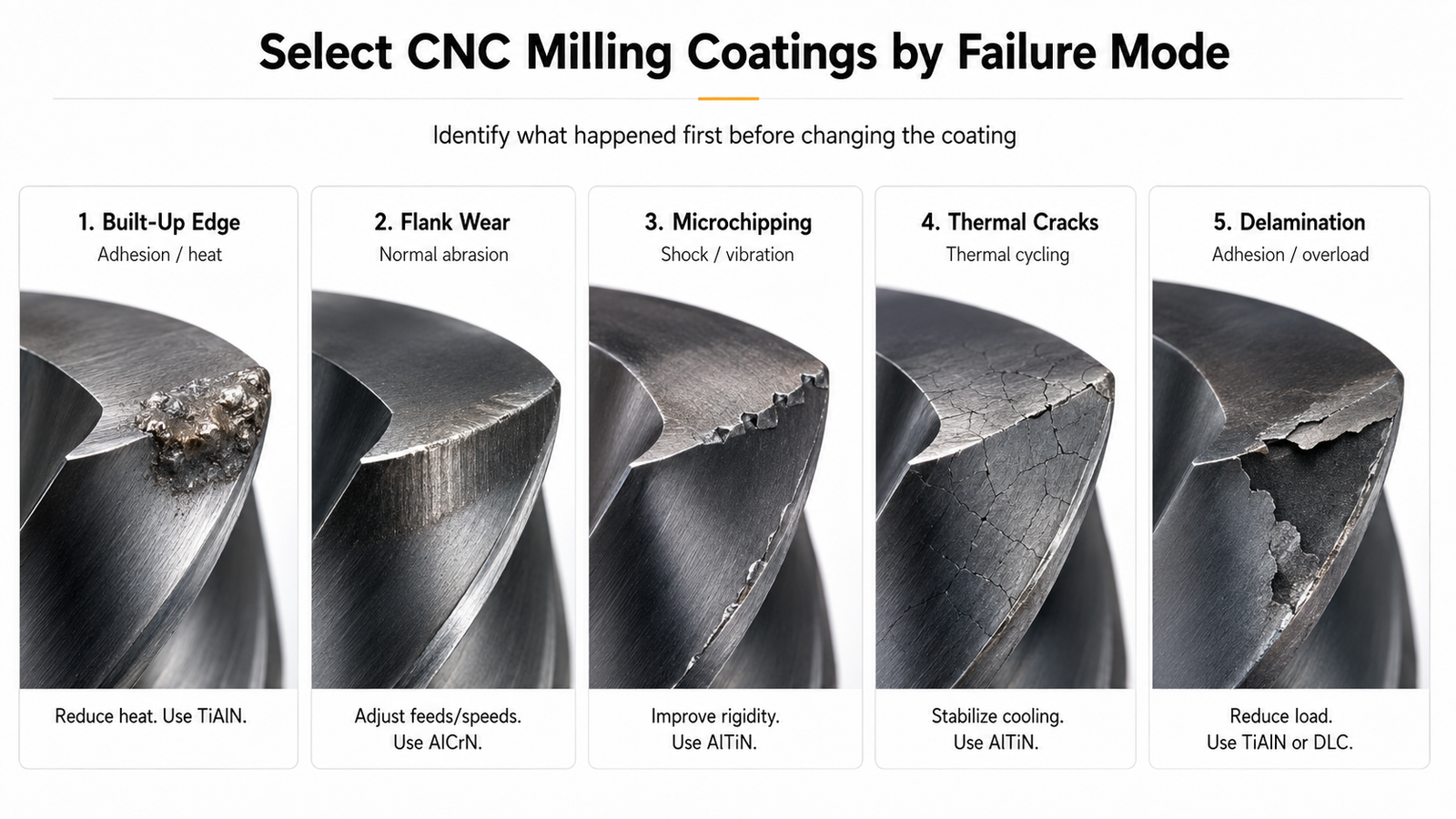
| Observed problem | Likely mechanism | Coating direction | Process checks before changing coating |
|---|---|---|---|
| Material welded to the edge | Adhesion, heat and poor evacuation | Lower-affinity, smoother coating such as TiB2, ZrN or suitable DLC for aluminum | Flute polish, chip space, coolant or air delivery, speed and chip thickness |
| Even flank wear on all flutes | Normal abrasion | Harder or more wear-resistant layer; diamond for suitable abrasive non-ferrous work | Cutting speed, total path length and whether all flutes share load |
| One flute fails before the others | Runout, uneven edge prep or localized damage | No coating change until load sharing is corrected | Holder cleanliness, collet, spindle interface, runout and tool balance |
| Random microchipping | Mechanical shock, vibration or an edge that is too brittle | Tougher coating-substrate system or lighter edge preparation | Overhang, fixture, radial engagement, entry move and chip recutting |
| Regular cracks across the edge | Thermal cycling | Coating designed for thermal shock and the selected coolant strategy | Intermittent coolant contact, air pockets, entry and exit frequency |
| Coating peels or flakes early | Adhesion, residual stress, substrate preparation or overload | Supplier review of pretreatment, interlayer and coating thickness | Confirm whether flaking is the cause or the result of edge fracture |
| Burrs or poor finish with little visible wear | Edge radius, rubbing, runout or deflection | Thinner coating or sharper edge preparation | Feed per tooth, runout, tool deflection and workholding |
| Damage at one axial line | Notch wear or repeated engagement boundary | Application-specific heat and adhesion-resistant system | Vary axial depth, improve toolpath and review work-hardened surface or scale |
This diagnostic approach prevents a common and expensive mistake: replacing a chipped tool with a harder, more brittle coating when the real cause is runout or vibration.
Coated vs Uncoated End Mills
Coated end mills usually earn their cost in stable production, abrasive materials and heat-intensive cutting. Uncoated carbide can still be the correct technical choice when the process needs the sharpest possible edge, the material tends to adhere, the batch is small, or coating thickness is significant relative to a micro-tool edge.
- Choose coated carbide when a known wear or heat mechanism limits an otherwise stable process.
- Choose polished uncoated carbide when sharpness and chip release dominate, especially in many aluminum and plastic operations.
- Do not compare purchase price alone. Compare tool cost per acceptable part, machine time, tool changes, scrap and process variation.
- Do not change geometry and coating at the same time if the goal is to learn which coating performs better.
How to Test End Mill Coatings Without Misleading Yourself
A coating test is useful only when the comparison isolates the coating and measures a business result.
- Use end mills from the same carbide lot where practical, with the same diameter, flute geometry, edge preparation and dimensional tolerance.
- Measure holder and assembled-tool runout before each test. Record the value instead of writing “good.”
- Keep toolpath, radial engagement, axial depth, speed, feed, coolant concentration and delivery method unchanged.
- Define the stopping rule before cutting. Suitable limits include flank-wear width, dimensional drift, burr height, surface roughness or a fixed number of parts.
- Run more than one tool per coating. A single tool cannot separate coating performance from tool-to-tool variation.
- Inspect wear at fixed intervals and photograph the same flute locations at the same magnification.
- Calculate cost per acceptable part and productive machine time, not only minutes until breakage.
For production validation, the best coating is the one that produces the lowest repeatable cost at the required quality and process capability. It is not necessarily the coating with the highest catalog hardness.
How to Specify Custom Coated Carbide End Mills
Custom coated carbide end mills perform best when the coating is specified together with the substrate, geometry and edge preparation. A useful request for quotation gives the toolmaker enough information to select those elements as one cutting system.
- Workpiece standard, grade, hardness, heat treatment and abrasive or silicon content.
- Operation type, toolpath, axial depth, radial engagement and entry method.
- Finished feature dimensions, tolerance, corner radius and surface-finish requirement.
- Machine spindle interface, maximum speed, available power and coolant method.
- Holder type, required reach, gauge length and measured runout target.
- Current tool, cutting data, tool life and photographed failure mode.
- Batch size, annual volume, regrind policy and target cost per part.
- Any restricted substances, coating documentation or traceability requirements.
Review the available CNC cutting tool range and discuss end mill geometry before freezing the coating specification. A different flute count, helix, rake, core or edge hone may solve the failure more directly than another coating.
Need a material-specific end mill? Browse KXT CNC cutting tools, review our custom cutting tool service, or send KXT your machining conditions. Include the eight RFQ items above so the recommendation can address the complete cutting system.
Frequently Asked Questions About End Mill Coatings
What is the best all-purpose end mill coating?
There is no all-purpose winner. TiAlN or AlTiN is a broad starting choice for many ferrous materials, while polished uncoated carbide, TiB2, ZrN or DLC is more suitable for many aluminum applications. Diamond is reserved for highly abrasive non-ferrous and non-metallic work.
Can you use TiAlN on aluminum?
Generally, no. Aluminum-bearing nitride coatings can promote adhesion when cutting aluminum. Start with polished uncoated carbide, TiB2, ZrN, DLC or diamond according to alloy abrasiveness, operation and production volume.
Is AlTiN better than TiAlN?
Not in every application. AlTiN is often selected for stronger oxidation and high-temperature performance, while TiAlN may offer a different balance of hardness, friction, stress and toughness. Names and compositions vary by supplier, so compare complete coating specifications and test them on equivalent tools.
Is TiCN better than TiN?
TiCN often provides greater hardness and abrasive wear resistance than TiN, but it may have a lower useful temperature range. TiCN is better when wear dominates and heat is controlled. TiN remains a practical baseline for moderate general-purpose ferrous machining.
When should I use a DLC coated end mill?
Use a DLC coated end mill when low friction and resistance to material adhesion are important in aluminum or another approved non-ferrous material. Confirm the exact DLC formulation because DLC products differ in structure, thickness and thermal limits.
What is the best graphite end mill coating?
CVD diamond is normally the first family to evaluate because graphite is highly abrasive. Choose layer thickness and tool geometry according to feature size, finish, corner detail and production length.
Does a harder coating always last longer?
No. A hard coating can fail early if it is too brittle for an interrupted cut, has poor adhesion, rounds the edge, or is used on a weak setup. Toughness, residual stress, substrate, edge preparation and thermal cycling matter alongside hardness.
Should coated end mills run dry?
Only when the toolmaker approves dry cutting for the coating, material and operation. Some high-temperature coatings perform well dry because heat leaves with the chip. Stainless, titanium and deep-pocket applications may still need dependable coolant. Inconsistent wetting can be worse than a controlled dry or wet strategy.
Can carbide end mills be recoated?
Often, yes, if enough tool material remains and the supplier can strip, regrind, edge-prepare and recoat without moving critical dimensions outside tolerance. Reground tools should be qualified like a new process because diameter, flute form and edge preparation may change.
How do I compare coating claims from different suppliers?
Request composition, layer architecture, deposition method, thickness, hardness test method, friction test pair, maximum-temperature test basis, substrate, edge preparation and recommended applications. Then run a controlled cost-per-part test. Do not compare isolated catalog numbers as if they came from one standard test.
Final Selection Rule
Choose an end mill coating in this order: exact workpiece, operation, dominant failure mode, required edge shape, thermal strategy, tool geometry and controlled test result. For aluminum, begin with sharpness and anti-adhesion. For steels and difficult alloys, balance hot hardness with toughness. For graphite and composites, prioritize abrasion resistance. When two tools share the same coating name, assume they are different until the specifications prove otherwise.
That method is slower than picking the darkest or hardest coating from a chart, but it is far more likely to produce stable tool life, predictable finish and a lower cost per acceptable part.
Technical Sources
The following manufacturer and search-engine documents were checked for this guide. Technical values remain product-specific and should not be treated as universal coating constants.
- Harvey Tool: Tool Coatings for Ferrous and Non-Ferrous Materials. Application guidance and comparative properties for TiN, AlTiN, ZrN, TiB2, amorphous diamond, CVD diamond and PCD.
- Harvey Tool: End Mills for Hardened Steels. Current coating and hardness-range examples for hardened-steel finishing tools.
- OSG: DLC Coated Carbide End Mills for Non-Ferrous Materials. Manufacturer guidance for DLC tools used on aluminum and other non-ferrous materials.
- Oerlikon Balzers: TiAlN-Based and AlTiN-Based Coatings. Supplier comparison of the related coating families.
- Seco Tools: A Guide to Milling Grades, Materials and Solutions. PVD and CVD overview and guidance on balancing grade, coating and geometry.
- Oerlikon Balzers: DOMINO Coating Matrix. Comparative composition, hardness and working-temperature data for commercial coating systems.
- Oerlikon Balzers: Coating for Difficult-to-Cut Materials. Application guidance for titanium, nickel-based alloys, stainless and hardened steel.
- Google Search Central: Optimizing for Generative AI Features. Official guidance confirming that helpful, reliable, crawlable and non-commodity content remains the foundation for AI Overviews and AI Mode.